TECHNIQUE

Strength Training

Every other tool in this clinic buys a window. Loading is what we spend it on — because tissue that can carry more, hurts less.

AT A GLANCE

Pain usually means demand has outrun capacity. Massage, needles, and mobilization can turn symptoms down — but only progressive loading turns capacity up. That's why some form of strength work sits inside nearly every plan of care at Post Falls Physical Therapy, dosed to your tissue and coached rep by rep in one-on-one sessions.

The active ingredient

Strip any successful rehab program down to what actually produced the change and you'll almost always find the same thing: load, applied progressively, over weeks. Muscle responds to it by adding contractile tissue. Tendon responds by reorganizing and stiffening in the useful sense of the word. Bone responds by laying down density. No passive treatment produces those adaptations — they only come from asking the tissue to do slightly more than it's used to, then letting it adapt.

This is also why programs fail in both directions. Too little challenge and nothing adapts; you do your band exercises for months and stay fragile. Too much too fast and the tissue flares. The skill isn't picking exercises — it's picking doses.

Exercise is a prescription

We treat sets, reps, load, tempo, and rest the way a physician treats milligrams. A mid-stage tendon problem might get slow, heavy work twice a week; an irritable post-op knee might start with isometrics it can tolerate today; a deconditioned back gets volume before intensity. The prescription changes week to week based on how your tissue responds — which we know, because the same therapist sees you every visit and retests your numbers.

Patient performing a coached barbell exercise
The barbell is one entry point of many — the principle is progressive, coached challenge.

Sore is not the same as harmed

The biggest myth we un-teach: that pain during exercise means damage. A systematic review of trials comparing painful versus pain-free rehab exercise found that allowing some symptoms during loading did not worsen outcomes — and in the short term slightly favored the groups that pushed into tolerable discomfort.[3] We give every patient explicit traffic-light rules: what's acceptable during a session, what should settle by the next morning, and what means we adjust the dose.

What the research shows

EVIDENCE SYNTHESIS · TENDINOPATHY

Across the tendinopathy literature, exercise therapy is the backbone intervention — feasible, acceptable, and effective as first-line care.

View study →
META-ANALYSIS · DOSING

Outcomes in tendinopathy management track with how resistance exercise is dosed — supporting individualized prescription over generic protocols.

View study →
SYSTEMATIC REVIEW · PAIN RULES

Protocols allowing tolerable pain during rehab exercise performed at least as well as pain-free protocols across randomized trials.

View study →

Coached, not handed a sheet

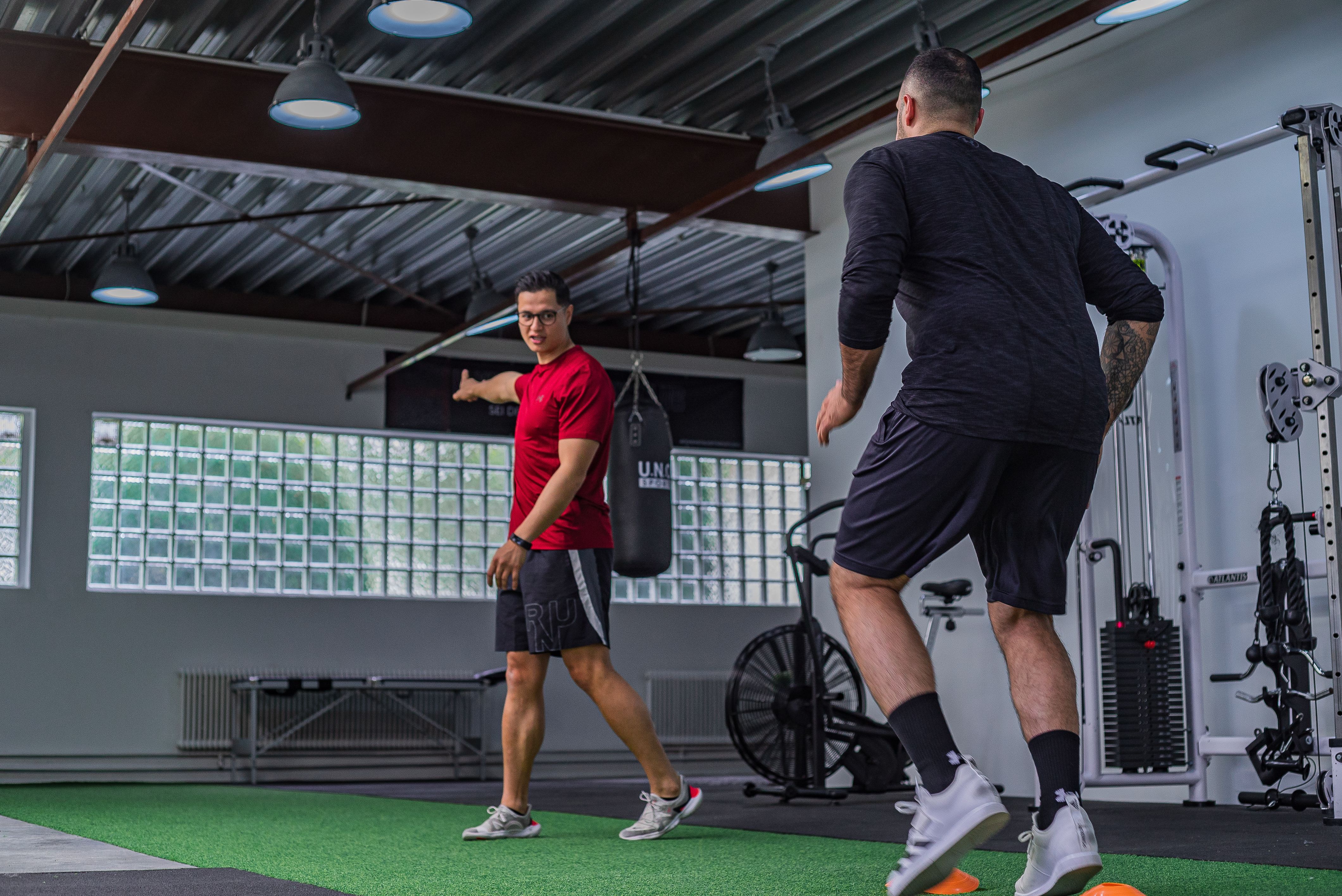
Our clinic floor has racks, dumbbells, bands, and cuffs for a reason: strength work happens here, supervised, inside your 45-minute session — then gets distilled into a short program you can run at home or in your gym.

  • Baseline numbers first: we measure strength before we train it, so progress is a fact, not a feeling.
  • Entry point matched to irritability: isometrics, tempo work, or full loading depending on what your tissue tolerates today.
  • Form coached rep by rep: the same movement done poorly and done well are two different treatments.
  • Progression written down: you always know what you're lifting, why, and what unlocks the next stage.

Often paired with

Resistance band shoulder exercise coached in the clinic
01 — MEASURE
Test the baseline

Objective strength and capacity testing so the plan starts from data.

02 — DOSE
Prescribe the load

Sets, reps, tempo, and intensity matched to your tissue and stage.

03 — PROGRESS
Raise the ceiling

Retest, progress, and hand you a program you can keep running without us.

Frequently asked questions

I'm in pain — shouldn't I rest instead of lift?+
Rest calms symptoms but shrinks capacity, so the same task hurts again the moment you return to it. For most musculoskeletal problems, the durable exit is raising what your tissue can tolerate — done gradually, at a dose your therapist controls. Some soreness during rehab exercise is acceptable and, per the research, doesn't worsen outcomes.
Am I going to be doing heavy barbell lifts?+
Only if and when that's the right dose for you. Strength training in rehab spans isometric holds, bands, and bodyweight through to loaded squats and hinges. The principle is progressive challenge, not any particular piece of equipment — an 80-year-old recovering from a fall and a 20-year-old athlete both strength train, just at very different entry points.
What's wrong with the sheet of exercises I got somewhere else?+
Usually two things: the dose is a guess, and no one ever watched you do them. The difference between an exercise that rebuilds a tendon and one that annoys it is load, tempo, and form — details that need coaching and adjusting week to week. That's why our strength work happens inside one-on-one sessions, not on a printout.
How long before I actually get stronger?+
You'll likely feel steadier within two to three weeks — early gains are mostly your nervous system coordinating better. Structural muscle and tendon change builds over six to twelve weeks, which is why plans of care are measured in weeks and why we retest your strength with numbers rather than impressions.
ONE PATIENT, ONE HOUR, ONE FOCUS

Build the capacity your body is asking for.

Individually dosed, coached strength work — no referral needed in Idaho.

Ryan Zumwalt
DPT · DOCTOR OF PHYSICAL THERAPY

Ryan Zumwalt, DPT practices at Post Falls Physical Therapy in Post Falls, Idaho, where every session is one-on-one with the same Doctor of Physical Therapy.

SOURCES

  1. Exercise therapy for tendinopathy: a mixed-methods evidence synthesis. 2023. pubmed.ncbi.nlm.nih.gov
  2. Effect of resistance exercise dose components for tendinopathy management: a systematic review with meta-analysis. ncbi.nlm.nih.gov
  3. Should exercises be painful in the management of chronic musculoskeletal pain? A systematic review and meta-analysis. Br J Sports Med. ncbi.nlm.nih.gov
  4. The Role of Physical Exercise in Chronic Musculoskeletal Pain: Best Medicine — A Narrative Review. 2024. pmc.ncbi.nlm.nih.gov